Showing posts with label culture. Show all posts

Thursday, November 14, 2013

Lost and Found in Addis

I walk through the cool, dusty morning toward the blue domes of a nearby church, blurry from a night of insomnia. My camera is heavy in my bag, my skin prickles under my jacket from the chill.

The gate to the Bole Medhane Alem, an Ethiopian Orthodox church, is flanked by women selling incense, their heads covered in thin, white cloth. One speaks to me in Amharic until she realizes I can't understand. A man is kneeling beside me, head touched to the cement.

As I enter the gates, the stained glass windows and pillars come into full view. The church is fairly new, with smooth walls and marble floors. I step slowly, first to snap photos, and then because I realize I know nothing about this tradition or its rituals or how to respect the faithful.

Watching the women around me -- most dressed in long skirts and yards of white cotton wrapped around their shoulders and heads -- I pull out the silk scarf I use to protect my camera lens and cover my hair. I step up to the door of the church where people have discarded their shoes and several are kneeling at the entrance.

I've observed many houses of religion in different coutries, but never seen this kind of prayer. Women cross themselves, and then pray with their hands outstretched to the ceiling, almost as if wailing, but with little sound. They move their palms close and then apart, and bow repeatedly. The bare feet, the incense -- these remind me of temples in India. But the light filtering through blue glass, the gilded altar -- this reminds me of Rome.

I make my way around the biggest church in Addis and enter through the main door.

Sitting in a pew in the church, someone's walking cane at my feet, I am suddenly overwhelmed. There are sonorous chants and whispers and men and women bowing their heads to the ground in every corner, murmering toward the altar. But I also feel a deep sorrow, an ache like hunger in my stomach, a shortness of breath in my lungs. Tears crawling slowly from my eyes.

I sit for minutes that feel like hours, words forming in my mind and then quickly dissipating, meditating on the women before me whose faces seem to be etched with unanswered prayers. I wonder if this is the culmination of the last few non-stop days -- of asking so many questions, of soaking in so many familiar, yet completely foreign, sites. The unrestrained reflection of the hungry children that have always, and will always, circle in my mind in every country.

Eventually, a woman walks over to me and grabs my hand with a smile. "Sit here," she says, leading me to her pew and I realize I've been unraveling on the men's side. We meet eyes and laugh and I sit with her for a minute before turning around to leave.

Wednesday, August 21, 2013

The Millenial Revolution

I am a product of my generation.

My grandparents left behind continents and community, seeking opportunity. My parents worked long, hard hours for quiet, peaceful stability. And I -- well I'm driven by the need for constant engagement, a path that is interesting and uncertain and full of the kind of life that smacks you in the face so you can't look back. A path that allowed me to make mistakes in at least three different countries.

A big house and a nice car have little allure for my kind of millenial. Big houses have mortgages and pools that need constant maintenance. Big houses are full of closets with stuff -- stuff that keeps you from moving when you want to see or do something new. I like pretty dresses too, but not at the cost of mobility, or knowing the burden that my accumulation of stuff puts on other people far from home.

And when I see senseless violence, like the open fire on preschools and pedestrians yesterday, and revolutions that end where they started, I know it's not random. Because those beautiful homes on the water are attached to bigger lawns. Not enough land to grow much, but the kind that put considerable space  between you and the neighbor.

I went to "gifted" public schools where I was asked to answer many questions, but never about the missing students. The ones whose parents didn't have time to teach them thousands of words when they were young, or trace the shapes, or learn the colors by mixing different kinds of paint.  And the missing students, hidden in their own schools, weren't asked about it either.

For the few years that I rode a bus with kids that were financially poorer than me,  I remember feeling uneasy. I remember when Brian told everyone I had a 'big house'. I remember cigarettes in sixth grade, kids bullying the bus driver because of his accent -- the extra syllable when he said bus stop. I remember using the word "fuck" for the first time and trying to mask how weird it felt.

I felt just as unsettled with the kids who had everything they wanted. They had three jet skis and huge wardrobes and still wanted all of these things in all of these catalogs I hadn't seen before. But I remember thinking their lives seemed more complicated than mine -- more rules, more faces to put on in front of more people.

My discomfort was part of the segregation -- not just black and white and brown, but so much more -- that defines a fractured society. One where everybody, regardless of their circumstance, is left without choices. And without the dialogue that should have happened, in the classroom and at home and on the bus, it has become so easy to dehumanize each other. Easy not to see someone as your brother or sister. Easy to think of someone as "the other".

It's the other that gets overlooked and diminished. It's just too easy to hurt the other without feeling the gnawing, unsettling pain of how it feels to hurt your own family and friends. And creating this class of others is a task that all sides seem to have inherited regardless of their wealth or race or circumstance.

But there are signs of light, there are always signs of light.

I think my generation is looking to add to their families, to extend love past their walls. It's apparent in the way we travel. It lives in our efforts to build community, from hipsters with community gardens to "disenfranchised" golden children returning to their roots because escaping was never the solution to success. And we have finally started to value and look up to those who learn and produce and grow without too much emphasis on the institutions or labels behind them.

And even though we plug in and tune out, I think our phones might actually be making us smart. The globalization of information has produced idealists (though sometimes misdirected like I have been many times) because a wireless connection can extend farther than we ever thought possible. Our Twitter feeds can start movements, our Facebooks promote campaigns, our Skype accounts connect us to people otherwise forgotten in so many ways. People complain that there are too many opinions being voiced, but there are also thousands of avenues to hear them.

All we really need to do is listen.

Tuesday, June 11, 2013

What Selfies Don't Tell Us

Behold, the original selfie.

Vincent van Gogh painted a slew of these during his lifetime, using a mirror to carefully reconstruct his face with both careful and rapid strokes. With hat, without hat, with paint, without ear. These portraits are the most valued of his work, for good reason.

But our generation doesn't usually do self portraits. We do selfies. We take them in the mirror, with our camera in hand, or with the flip function. We shoot our good side, and then choose a filter to make it our even better side.

We hold our phones, our camera, our friend's phones, iPads, Photobooth at a bit of a distance, and just a little bit higher than our head, because that's what makes your cheekbones protrude, and that's what makes your eyes look bigger. And then we take photos with our friends, and we purse our lips and look at each other from the corner of our eyes, and capture each time we reunite, each time we have adventure.

We fill our phones with apps to be able to do this, and spend time at dinner tables and on the train to make a collage of various moments, and outfits and dangling earrings.

And man, we think, it will be great to have these later. It will be great to remember his wedding and that time you and your friend fell on the ground at the music festival, and that day when you were stuck in the cold rain-hail with hair plastered to your face under a red hood, and needed to share in the misery via Instagram. You can show your kids someday.

But it's different, a little less real.

Because selfies are so quick, and so flippant, and so perfectly positioned to capture the same aspect of you, again and again. If you were painting a self portrait, you wouldn't be able to hold a fake smile so long, or forgive yourself for keeping your lips like that. If someone else was taking your photo, they wouldn't be concentrating on hiding that scar you got when you were four, because they could see you as more than the sum of your features.

We take selfies to remember, we take selfies to get compliments, and that's cool, even great.  There's nothing wrong with looking at ourselves -- it's a natural sort of naval gazing. A historic, sometimes healthy, narcissism.

But we don't, can't, use selfies to self-reflect, because even our reflection in the mirror is more true than what fits in a Picframe.  The lens is skewed. It's limiting, and edited to fit the boundaries of who we think we are. And everyone knows we are much, much more.

In any case:


Thursday, April 25, 2013

Locks of [Unrequited] Love: The Myth Of "Good" Hair


Shakeeda navigates my hair with her pointer finger, skimming the asymmetrical hairline and coaxing a snarl into submission. I study the African-themed border on the golden wall, trying not to flinch.

“I’m sorry. It’s a mess,” I say, leaning back to fix my neck into the crevice of the basin. Apologies have been a standard part of my salon regimen for almost 18 years now, ever since baby curls gave way to a chaotic mass of corkscrews that perpetually threaten to become dreadlocks.

“Girl, I’ve seen some things,” Shakeeda says, maneuvering her cumbersome body to the other side of the sink. “This is not a mess.”

Her words, like the nimble hands massaging shampoo into foam, are comforting. I grew up the frizzy black sheep in a family of Indian women with silky hair cascading down their backs. My cousins and aunts are oblivious to split ends and humidity and buying extra strong hair ties -- weddings and baby showers are like a cheesy L’OrĂ©al commercial, every hair toss more mesmerizing than the one before.

My mother is no exception and spent most of my middle school evenings forcing me toward a patio chair with a blue bottle of Parachute coconut oil and unprecedented faith. The next morning I would scrub my head until the hot water ran out, worried that the pungent aftermath of her childhood Indian hair remedy would scare away Science class suitors.

Now, in my favorite Harlem salon, Shakeeda does a final rinse, drapes a black apron over my shoulders, and leads me to the workstation. I look at our reflection in the mirror, taking in her pleasant face; a large, flat nose fixed firmly between high cheekbones. Her hair, I deduce, is a weave, fixed tightly at the root. It falls in perfect, jet-black rivets to her round shoulders with no trace of defiance.

“You need a trim,” she says, examining my hair between her thumb and forefinger. “How long has it been?”

“About four months -- since October,” I say, proudly. I’ve been known to wait a year. Or two.

“October! October!” She throws her hands up. “You will come in every two months from now on. We’re not letting this happen again.”

I’ve already bestowed the woman with rare and complete trust, so I agree to almost everything she says. I will not wash my hair every day. I will go to the beauty supplies shop on 125th street, across from the H&M, and buy the entire line of Cream of Nature products. And I will not relax my hair.

I will not relax my hair.

It took me eight years to not relax my hair. Our family hairdresser in Florida insisted on the chemical straightening treatment when I was in seventh grade, determined to run a hairbrush from root to tip without bristles breaking off the handle. She would do it for a special price, she told my mom, a flat rate of $350. I quickly agreed – disheartened by catching her despair via dramatic eye roll in the mirror when I would come in for a haircut.

At the time I was prone to masking my eyelids with Maybelline eyeshadow to match my favorite baby blue shirt. I had the seventh-grade version of a boyfriend, who I would chat with on instant messenger until ten o’clock. My best friend from the neighborhood had straight blonde hair. And my second best friend -- straight, dirty-blonde hair.

The first time I got my hair relaxed, it took six hours and half of the second Harry Potter book. People in the salon came to watch as Anita blow-dried my hair straight out until it stood on end like a lions mane, my tanned face a small oval in the center. My scalp tingled for days as if someone had rubbed acetone on an open wound. But it looked so damn good.

I wore it out, styled and long, to every class that month, including gym. I kept Herbal Essences hairspray in my backpack to spritz on extra floral scent. I felt like shouting down the halls: “Hey look at me, it’s the middle of a Florida summer and I still got this”. To top it off, my 13-year-old boyfriend was effusively supportive. “You look good,” he would mumble under his breath.

“You relaxed this?” Shakeeda shrieks when I recall the story that Friday evening. She holds up a wet spiral near my ear for emphasis. “This is great hair. People pay money for this.”

“People always tell me that,” I say. “Nobody would actually pay money for this.”

I’m about to launch into a rant comparing good to bad curls, but I bite my tongue. The last few years have been like a 12-step program in the battle of Ankita versus her hair, and I refuse to go back to a time when I preferred Britney Spears to Erykah Badu.

I had become a born-again hair virgin during my last year in college, days after my friend got drunk and compared my chemically damaged hair to a brillo pad. My friend Lynsey, who had recently liberated her own hair from weaves, gave me the final push I needed – forwarding me natural hair blogs and remedies involving honey and silk pillows. I was so chaste with my hair then that I all but gave up the straightening iron, blow drier and expensive serums.

Not everyone was impressed by my revolution. My family was visibly disturbed when I showed up to a wedding reception with my natural curls. “Did you even brush them?” My aunt asked in a hushed whisper as I got ready to hit the dance floor. I forced a smile, telling myself I was representing a whole generation of hair oppression, and proceeded to release my locks from a gasping butterfly clip.

Now, in solemn respect, I swallow the complaints, and ask my new fairy godmother for more hair advice.

“You know your hair feels it when you don’t show it love,” Shakeeda says as she shears the tendrils on either side of my eyes. “It’s only good to you if you’re going to reciprocate.”

I stop to consider this idea of my hair as a needy lover, and it’s clear that I haven’t had the best relationship. My last year before moving to New York was spent living in a backpack in northern India, away from the reaches of my affluent relatives. I slept and worked without air conditioning in 118 degrees, only aware of my physical appearance when my students would point it out in English class.

 “Ankita ma’am has very bunchy hairs,” 12-year-old Kajal would say, mapping out her subject and object.

“No, no,” I would say in response. “Hair is the same whether it is singular or plural.”

By the end of the year half my hair had fallen out from bucket baths, chlorinated water and a horrifying lice epidemic in our classroom. I wore my hair in a braid so often, I didn’t realize that the ends had frayed, or that there was a knot at the base of my neck so convoluted that it would eventually have to be cut out with scissors.

When I showed up in New York to attend Columbia University days after, I was quickly shamed into a haircut. I chose carefully– skipping the Upper West Side windows with Sarah Jessica Parker photos, and settling in a chair after Google searching Turning Heads Salon, rated best for “ethnic hair care” in Time Out magazine.

And that’s how I ended up in the slow, steady hands of Shakeeda, who doesn’t mind that it’s almost 7 p.m. and we’ve just started to blow-dry my hair for tomorrow’s job interview.

“You know, if you really love your hair, you would wear it natural tomorrow,” she says with a wink.

“I’m not there yet,” I tell her. Maybe soon.


Note: This essay was written back in March 2012. Just had to clarify so my employers don't think I'm interviewing for jobs. 

Wednesday, February 29, 2012

Awkward Culture

Earlier this week I took a yoga class at a new studio in Hell's Kitchen. In the first 10 minutes I was able to knock down my Klean Kanteen, spill water all over the floor, soak the bottom rim of my pantlegs and create some sort of foamy-suds effect on my mat. The rest of my practice followed suit -- slip-and-slide vinyasa flow, falling out of a headstand, the whole works. By the time we ended with namaste, I was exhausted, and not because of crow pose.

When I was little (no, that person above is not me), I remember visiting relatives in India, dangling my feet off a low bed, while my grandmother told our family I was "overconfident". I was too much of a fan of myself to be embarrassed.

In the past few years I've become more sensitive to little misspeaks, to tension, to bad timing. I freak out when I have to meet new people or interview them, even though I've never had a problem being social. Sometimes if I'm going to a party where I don't know many people, I have to give myself this cheesy pep talk (yeah, I admitted it) before I walk in the door. But thanks to social media, those moments are now chronicled in a mental Twitter account. Trying to network with an aloof editor? #mylifeisawkward Falling on the subway steps? #FML I have a feeling these little labels are making us ignore the fact the life is not meant to be smooth and elegant.

On the flip side, the current entertainment industry embraces awkward, plays it up and makes it okay. As if people got sick of the perfect, the picket fence and the straight blonde hair and presented a counterculture that was, actually, what they normally would have cut off and left on the floor of the editing room. Kind of like Freaks and Geeks, you know, before it was cool. There's that MTV show, "Awkward". There's Lena Dunham, a director/writer/actor you will know when HBO's Girls comes out, who essentially makes insecurity a whole plot line. Awkward Family Photos are pretty much the best thing ever, and make you feel happily normal with your own chaotic kin.

If you look at fashion, especially so-called hipster looks, awkward and beauty mesh together seamlessly in American Apparel jumpsuits. High pants and short sweaters and thick-framed glasses -- things you would never peg as flattering. In film, there's Napoleon Dynamite, Our Idiot Brother, Juno and Superbad. Michael Cera and Zooey Deschanel basically have a career because they play roles with squeaky voices and foot-in-mouth situations, and they do it well.

At the end of the ugly, the weird, the zoomed-in focus on zits and the lumpy bodies and verbal collisions, awkward culture is almost like an homage to the imperfect. It celebrates the lifey-ness, the subtle glamour, the grainy reality of being a human. I'm down with that.

Friday, December 31, 2010

Mubarak Mubarak

Staying for one year in India means I get to celebrate a complete cycle of festivals. And if you know anything about India, that is a lot of celebrating. So far I've watched Ravan fall during Dussera, lit diyas during Diwali, listened to the Guru Granth Sahib read at Guruparv, and eaten Sevaya for Eid.

I didn't expect the American holiday season to be a festive time here, but as globalization would have it, the last month has been chock full of reasons to eat and dance.

For Christmas there were at least four distinct events with my library kids. The holiday is much like the US version -- more cultural than religious in the community. In fact, not one of my kids is Christian to my knowledge.

A wonderful group of 20-somethings from eMagzin, a local internet collaborative, came to grant 50 kids their Christmas wishes. The presents ranged from pleather jackets to handheld video games. Luckily the miniskirt and toy gun wishes were exchanged for something else. Later on, a local discoteque (read: nightclub) hosted a sober, daytime dance party for the kids, with our own volunteer becoming a reluctant Santa Claus.

On actual Christmas Eve I upheld my own tradition of visiting a local church for mass. The Hindi-English ceremony transplanted "Prabhu Ishu" for Jesus, and half of the carols sounded like bhajans. While there are few Christians in Chandigarh, the massive Sector 19 Catholic Church was packed for midnight mass. A brown Christmas indeed.

My birthday celebrations also seemed to last all week. I distributed a less-than-perfect trifle pudding to coworkers and friends, and some chocolate biscuits to the kids. In turn, they were much more creative in their intricate cards for me, with poems such as "Rose is a red, Blue is a Blue, Hey teacher, I love you." I even got a little pop-out Taj Mahal, and a couple of toffees.

Later in the evening I gathered with the teenage boys group at my host family's house for a mini dance party and some cake. Even my host dad joined in with some Bhangra moves.

For my actual birthday my wishes were granted as it was the start of my only three days with my mom, dad and sister this year. Coinciding with my cousin's mehendi ceremony for a wedding, I got to cut a rich chocolate cake with my entire extended family around. Even though I've felt loved and supported all year, it was especially wonderful to be with the people who know me the best of all.

New Year, on the other hand, passed through my dreams. I fell asleep after writing reports at around 10:30 in the head of my NGO's house. At 6 a.m. I was woken up for a peace talk with Afghani youth, part of my organization's peace initiatives.

The first words I heard in 2011 were message of hope, of pain, and of the future.I don't mind trading in champagne for that.

Thursday, July 1, 2010

The Melted Pot

Indians are a GREAT target for laughs. We eat particularly pungent foods, watch the cheesiest movies, and have the thickest accents. Indian men have a weird talent to grow ear hair, and Indian women can hold grudges and gossip beyond a normal life span.

And yes, the kids, namely my generation, are just as hilarious. A third of us think we're White, a third think we're Black, and a third win the spelling bee. We all want to be doctors and lawyers -- at the same time.

My non-Indian friends sometimes tell me, "Indian racism is bullshit, you guys get all the good stereotypes." We get called smart, rich and tan. Not exactly fodder for the Anti-racist Alliance.

But something is rotten in the state of New Jersey and Indians are pissed off.

Not because Bobby Jindal and Nikki Haley converted to Christianity, or because yoga was secularized. Not because Sikh turbans are compromised at airports or because the only TV show we have is about outsourcing.

Indians across America are mad because one article by one semi-funny columnist has somehow catapulted minds back to the 1960s, when many of them first crossed into the West and found a new home despite a culture of segregation and intolerance.

Joel Stein, a regular humorist for Time magazine, published a clearly racist, insensitive and largely pathetic piece last week called "My Own Private India".

I came across the piece because someone was citing my own article in India Currents as "burn cream", an oasis after the fire that Stein created. When I clicked on the Time link I was hoping it would just be a case of oversensitivity. Funny guys often get cheap laughs by derailing other people. And honestly, I hardly get offended.

Basically, Stein is whining because his hometown of Edison has become "Little India". Once a slightly rundown spot where he could get away with stealing shit and lying and saying racial slurs, now Edison is a bustling baby-Delhi.

If you've been to Edison, you will know that this is true. My family goes there to work (dental and medical practices, go figure), wax nostalgic about eating bhel puri, and buy the lentils and spices that you don't get at A&P.

But this article was not just a lame joke. In one fell swoop, Stein managed to offend me on political, social, cultural, religious and academic grounds. He was anti-Hindu, anti-immigration and anti-intelligent all on one page. Not one line of his screed applied to me, but it was clear that these were the rantings of someone who couldn't handle change -- not to his hometown, his country, or his obvious flair for wanting to be a badass.

The only redeeming moment in the entire piece was quoting the mayor of Edison, NJ, who said flat out that Indians had brought prosperity to an otherwise dwindling economy.

C'mon Stein. I chuckled along plenty of times as if you were that obnoxious guy in the back of the classroom. But this was ridiculous. Would you say this about Black people? Or White people? Or Jewish people?

We shouldn't have to prove ourselves to America, because we are Americans. We shouldn't have to be smarter or richer than others just to claim that we have the right to be here. We shouldn't have to tout the beautiful things from our culture so that people understand why we're an asset to this country.

Regardless, at some point we did prove all of these things. At some point people got right off the airplane and went to work so that I could feel comfortable in my own skin, with my own background, in this country.

Guess what Joel Stein, you belong here, or in Edison, only as much as I do. Not more, not less.

Well, maybe a little less because you're a pain in the ass.

Tuesday, September 22, 2009

ETA

I was sitting in my Florida FlyIns class (group that I'm going to Brazil with) and listening to Professor Machado tell us about the Brazilian concept of time, and how one hour can mean three.

Well, I'm used to that, I thought. Indians have their own IST (Indian Standard Time) -- some kind of inherited trait that requires that we arrive at 9 p.m. to a 6:30 p.m. dinner party. For some of my friends, it's more than the usual hour -- they ring my doorbell at midnight and then leave for another party after hanging out for a while. And I remember a Jewish friend saying that his family has some form of this too.

When I was staying in Florence, Italian stores would pull down their aluminum shutters for lunch and return sometimes three or four hours later without notice. "American's work too much," a vendor told me one time when I asked about their inconsistent store hours. "They work all year, all day for just one expensive week in some exotic place. We Italians take these little vacations all the time, every day."

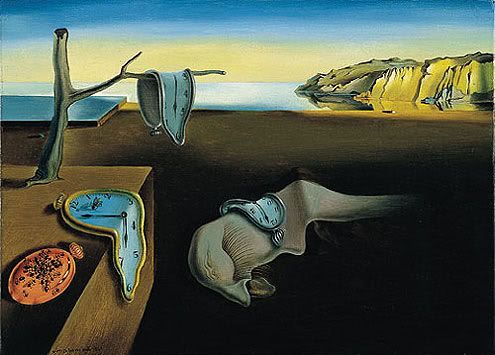
So if Brazilians, Italians, Latin Americans, Jewish families and Indians all see the clock like the ones in surreal Dali paintings, and time as relative, who exactly is getting places on time? An Irish friend I met in Barcelona told me that he loved German trains because they were on time, all the time. One of my high school friends spotted me rushing into the movie theater late and said, "Oh don't give me that culture crap, the movie started already." The 9-to-5 job schedule seems to have been written in the American Constitution.

I'm thinking about this today because my application for a Brazilian tourist visa was supposed to come to me two weeks ago and after many palpitations, e-mails and post office visits, should be in the mail tomorrow. But I have to admit that if my friends and family were running a consulate, it might have taken another year.

Wednesday, May 20, 2009

Simmerin'

I'm sitting on the periphery of my kitchen watching a pot of channa masala bubble on the stove, scared to touch it lest it becomes any worse. This is the only Indian dish I know how to make without a recipe book, and now that my family dinner is looking pretty weak, I might have to take it off the short list (pasta, omelette, grilled cheese).

And then I start wondering (because it has rained for four days and what else can you do?) if this is the channa masala metaphor of my life. By my age my mom was seeing suitors, taking care of her sister's children, and making several much more elaborate dishes by hand. Now she can feed an army (seriously...and if it's a family of four, the same amount of food will be made) in such a way that every heaping teaspoon of turmeric or coriander seed is perfect down to the grain. And even if she's a fellow vegetarian, her chicken biryani rivals the pit stops in Charminar.

Not that I want to feed the troops. Or get married by 23, or cook any more than my future husband will.

But is this diluted version of the delectable favorite a sign that my generation is destined to be just as watered down with culture? If my Hindi is, excuse me for this, "ghetto", will my kids be pronouncing their own names wrong? And while I can recite a few mantras and do pooja, my grandfather can recite scriptures for four hours without glancing down at a book.

This is what happens when it rains, and remains grey and the clouds are so burdened they almost touchdown to the river -- you hypothesize and dramatize all sorts of worldly things that are so irrelevant in Tarpon Springs.

In just a few weeks I'll be strapping on my Tevas and backpack and coursing through villages in North India without internet, cell phone or shaved legs. I will grow vegetables, treat sick children and touch the soil of villages my parents haven't even heard of before. And then, maybe, I will tell you, whether the channa masala metaphor stands.

Saturday, March 14, 2009

News Flash

Pillsbury is now selling frozen samosas.